A national builder was catching PPE non-compliance at the gate with manual checks. The checks were inconsistent, and the incidents were still happening.

The problem
The builder's Melbourne compound had a gate warden who visually checked every person entering. The warden was busy, the shift change was crowded, and the data on non-compliance lived in a paper logbook. The WHS team could not see patterns; they could only see incidents after someone had already entered the site without the right PPE.
Our deployment
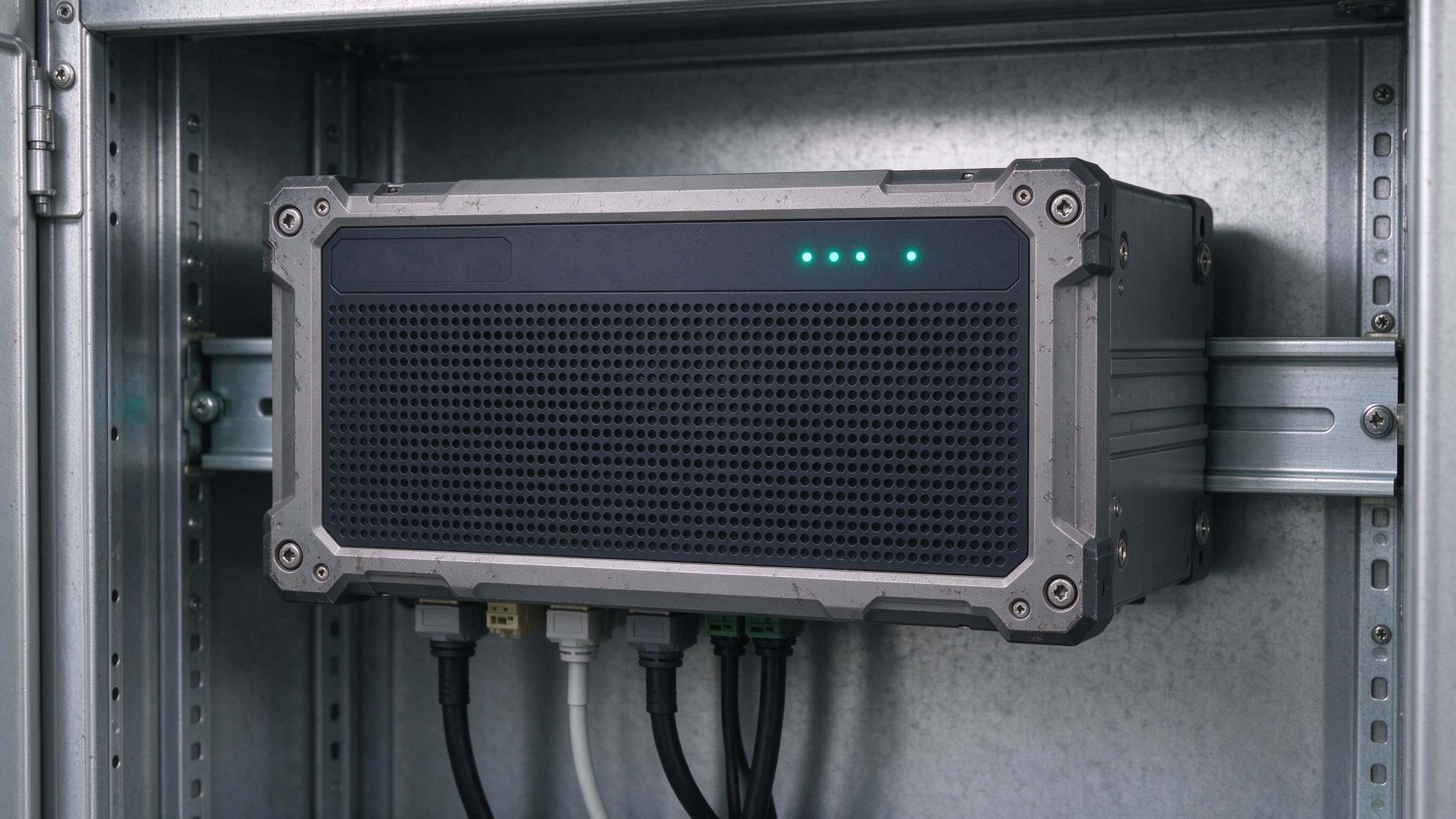
We installed a Canopy CU-2 unit at the gate, fed by a camera positioned to look at people as they approached the turnstile. The edge ran a PPE agent: hard hat, hi-vis vest, safety glasses. If a person approaching the gate was missing any of the three, the turnstile would not open. The WHS team got a count of near-misses by hour, not a list of names.
The result
The compound's network was unreliable — typical for a construction site on the edge of a city — but the edge unit kept working through outages. The WHS team now sees a daily report: how many near-misses, at which hour, at which gate. They do not see who.
Implementation details
The gate ran a Canopy CU-2 unit in a weatherised cabinet next to the turnstile. The camera was mounted at 3.2 metres, angled down at the approach lane. The PPE model was tuned on footage the builder provided during a two-week calibration period; we did not use any of that footage for general model training. The turnstile integration was via dry contact relay — a simple, fail-safe circuit that the site's electrician could wire in an afternoon.
When the edge detected a person without hard hat or hi-vis, it held the gate closed for 1.5 seconds, then opened if the condition cleared. If the condition persisted, the WHS officer received a Teams message with a zone and timestamp. No image was retained. The WHS team saw a count, not a photograph.
Before and after
The WHS team had logged around 12 near-misses per week on paper. The system counted around 25 per week, most of them at the gate. Incidents inside the compound fell to zero within a month.
The gate warden monitors a screen that flags exceptions instead of checking every person at a crowded shift change.
Ongoing support
The builder has since rolled the same pattern to three more compounds. We now provide a quarterly compliance report: near-miss counts by hour, by gate, by PPE type. The WHS team uses it to target inductions and signage. The edge discards frames, so there is no image to share.